A tour of the rooms of the Museu del Renaixement, the works on display and key themes
Walk through the museum rooms
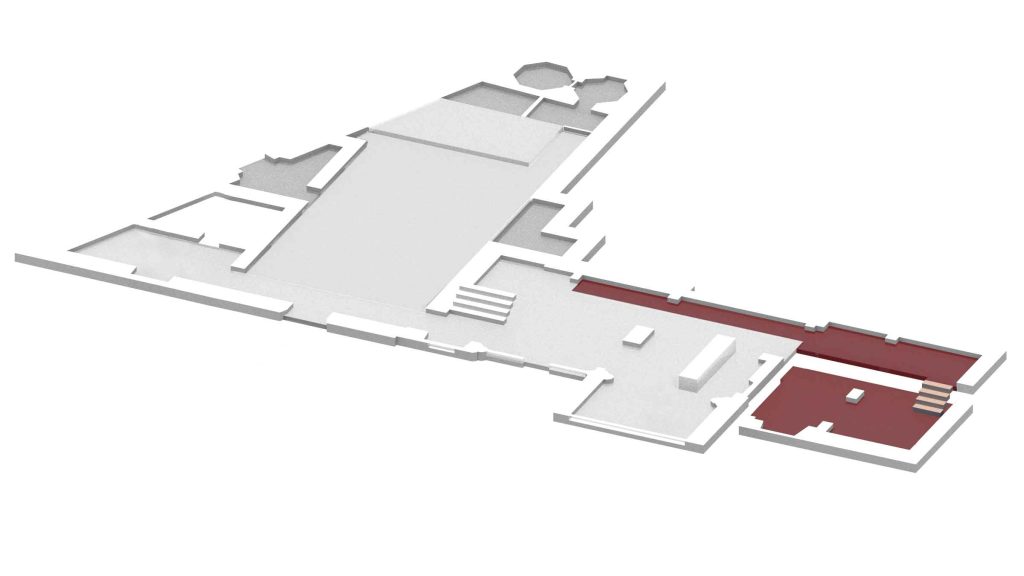
The story of the museum revolves around three key themes on each of the three floors: the history of the Requesens family in Molins de Rei, the principal characteristics of Renaissance art, and everyday life in the 16th century.
In 1430, King Alfonso the Magnanimous made Galceran de Requesens Lord of Molins de Rei. Shortly afterwards, work began on his palace, a large building with numerous rooms.
Most of the works in this room are decorative features from the old palace, but there are also others that are linked to the town, such as the original wayside cross.
Molins de Rei and the Palau de Requesens
Palau de Requesens, Molins de Rei
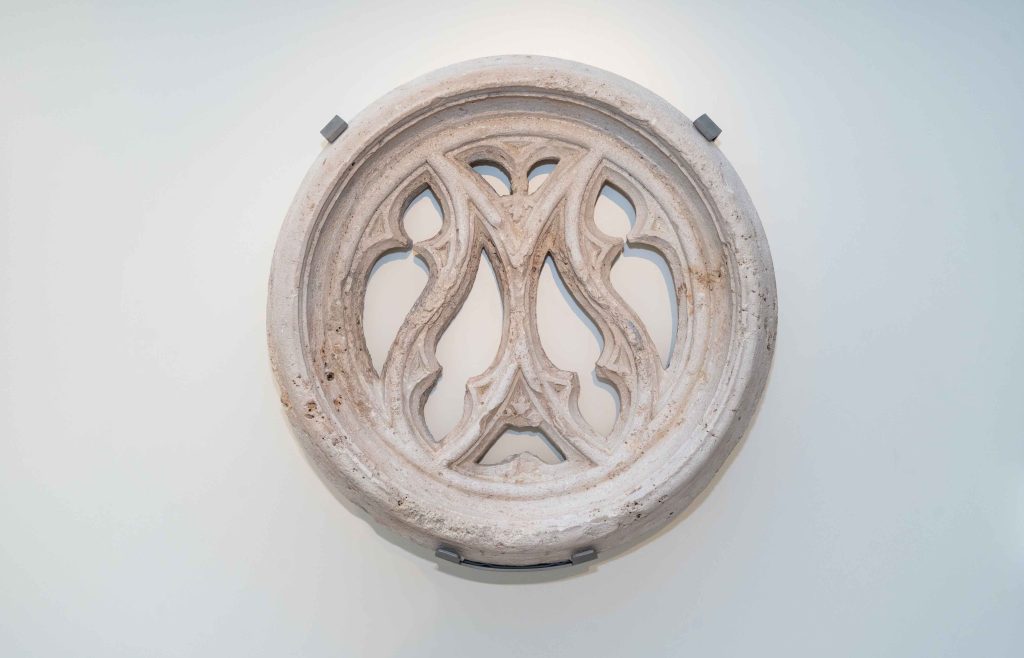
Claustra, 15th-16th century, carved from sedimentary rock Molins de Rei Town Council MMMR 2020
This sculptural feature was part of the original architecture of the palace, probably on the balustrade of the main staircase, which gave access to the main floor. It is a typical ornamental feature of the Gothic style, and had a dual function - aesthetic value, with the beautiful geometric fretwork, as well as to ease the weight of the structure of the staircase and at the same time provide ventilation. It is very likely that the palace staircase had other claustra like this one, of identical or similar design, which would have alternated with each other.
.
Palau de Requesens, Molins de Rei
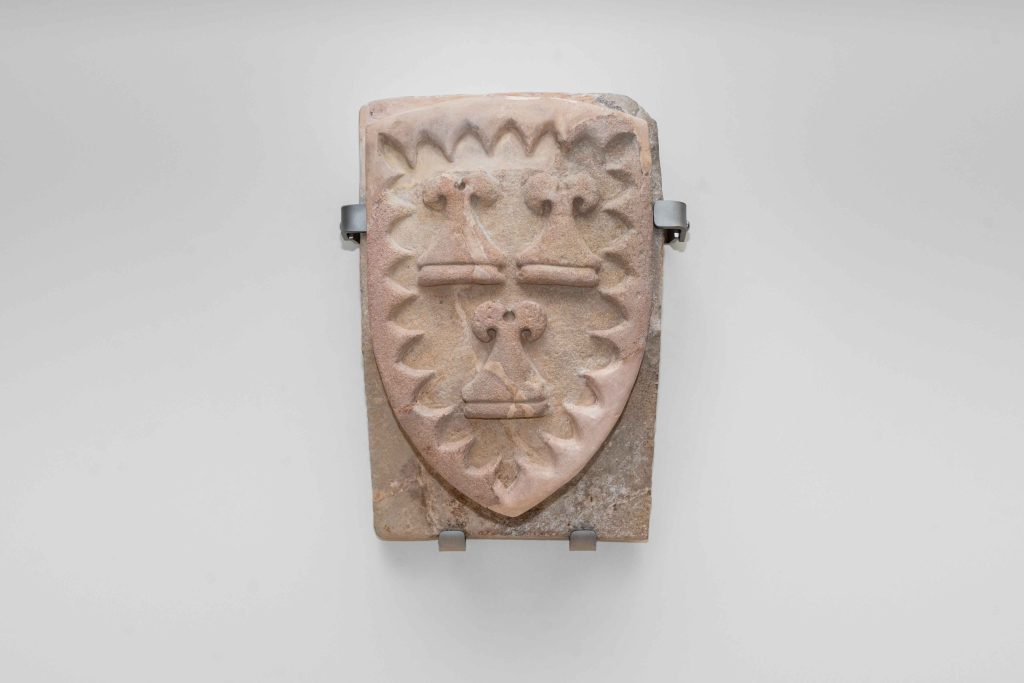
Requesens coat of arms, 15th-16th century, carved from sedimentary rock Molins de Rei Town Council MMMR 2017
The Requesens family coat of arms is easily identifiable due to its ogival shape and the three towers inside in a triangle, surrounded by a lace decoration. This one may have presided over the arch of the main entrance to the museum (where a modern reproduction now stands), but we do not know for sure. It was taken to the Municipal Museum of Molins de Rei, in C/ Pintor Fortuny, where it was preserved, and has recently been restored.
Palau de Requesens, Molins de Rei
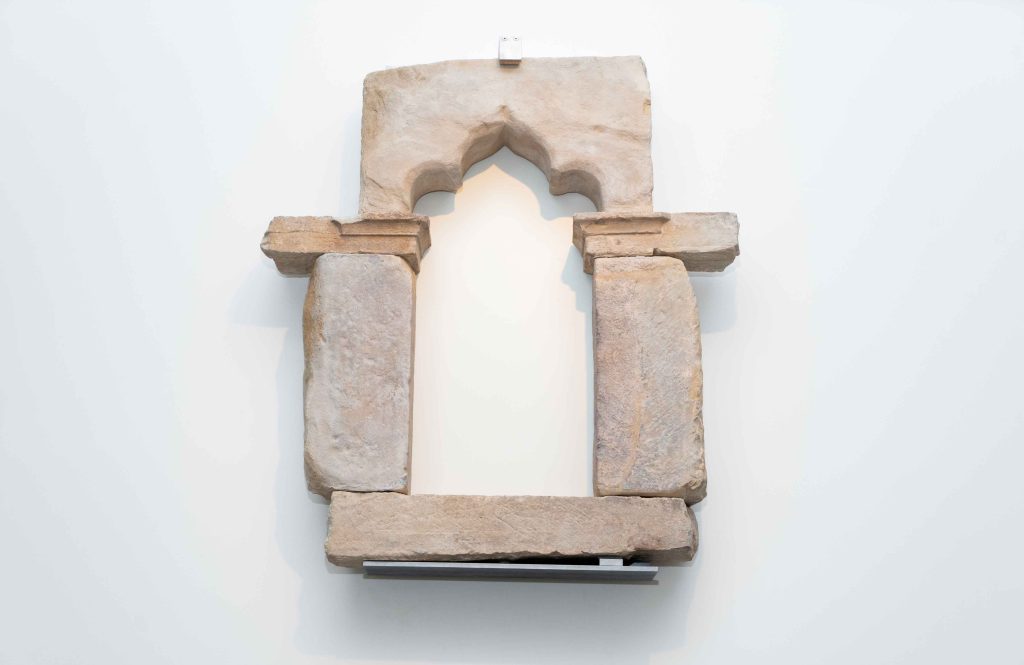
Window, 15th-16th century, carved from sedimentary rock Molins de Rei Town Council MMMR 3486
The original location that this window would have had in the palace is unknown. At some point it must have been dismantled, and then later reconstructed. The shape, with its delicate trefoil ogee arch, is clearly Gothic in style. It should be noted that in 1430, when construction of the palace began, the classicist language characteristic of the Renaissance, which was already popular in Italy had not yet arrived in Catalonia. Here the strength of the Gothic building tradition was very much alive and well.
.
Molins de Rei
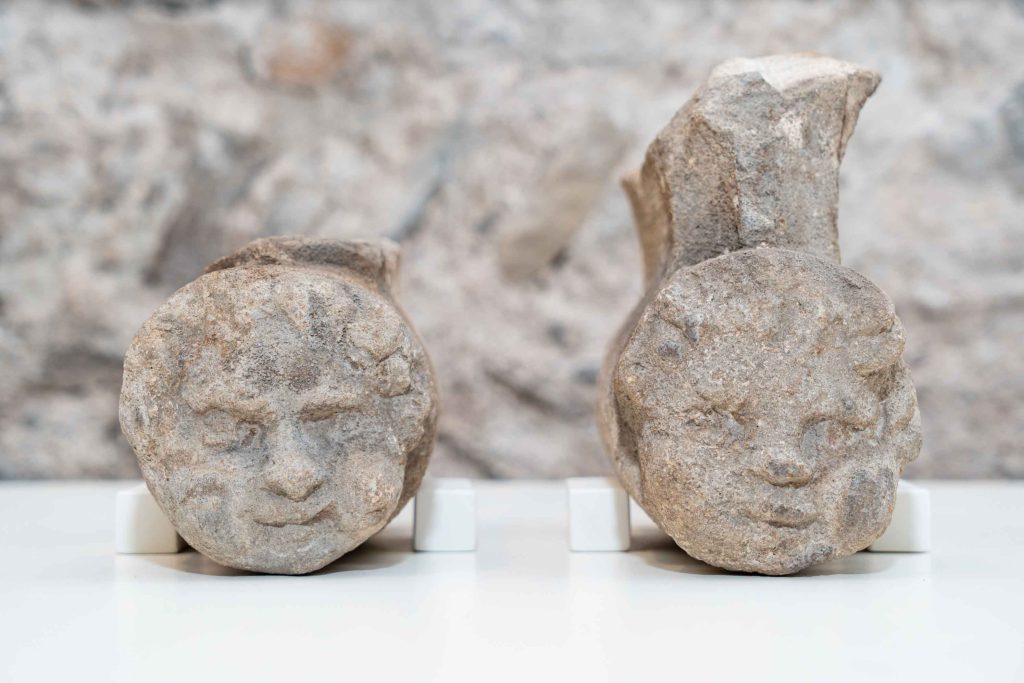
Two ornaments 15th-16th century, carved from sedimentary rock Molins de Rei Town Council MMMR 2036 and MMMR 2037
These two faces of children, angels or cherubs must have formed part of the decoration of an arch or window. We have no documentary certainty that they come from the Requesens Palace, but in any case, the small size and the care taken in the execution of their features and hair that can still be appreciated, reveal a great sensitivity in the desire to embellish, including even the smallest of details.
Molins de Rei
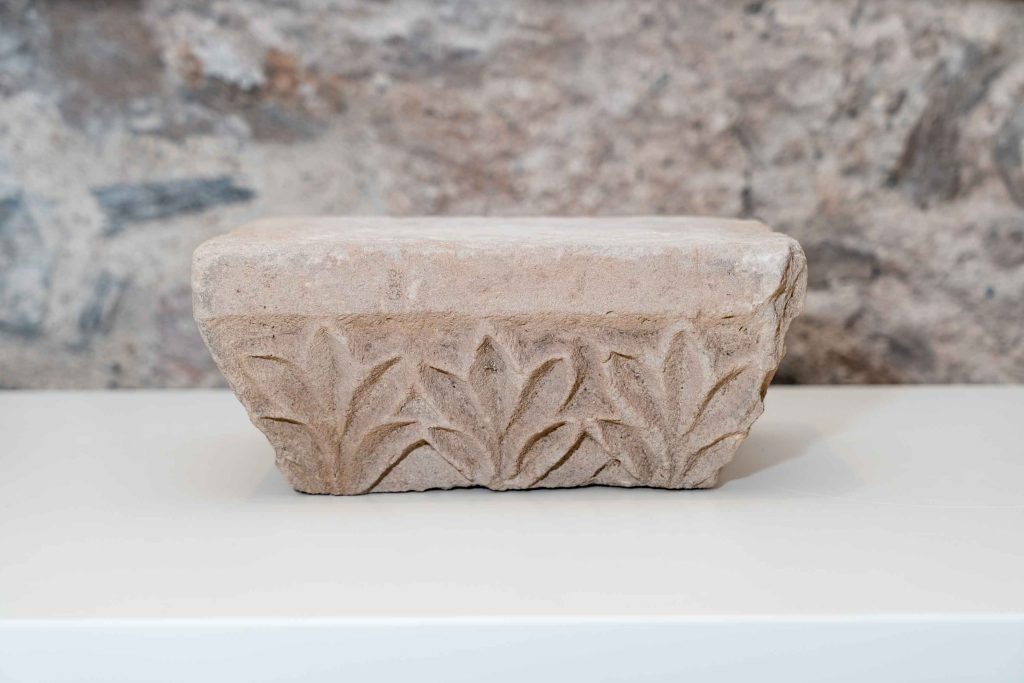
Impost, 15th-16th century, carved from sedimentary rock Molins de Rei Town Council MMMR 2027
This is a projecting block that marks a horizontal separation in the wall, and that can at the same time b at the same time, can be the starting point for an arch or a vault. These are usually decorated because they are highly visible, and have both a structural and an aesthetic function. This one is decorated with plant motifs that are almost geometrical in their repetition, creating a rhythmic effect of great beauty. We have no evidence that it comes from the Requesens Palace.
.
Palau de Requesens, Molins de Rei
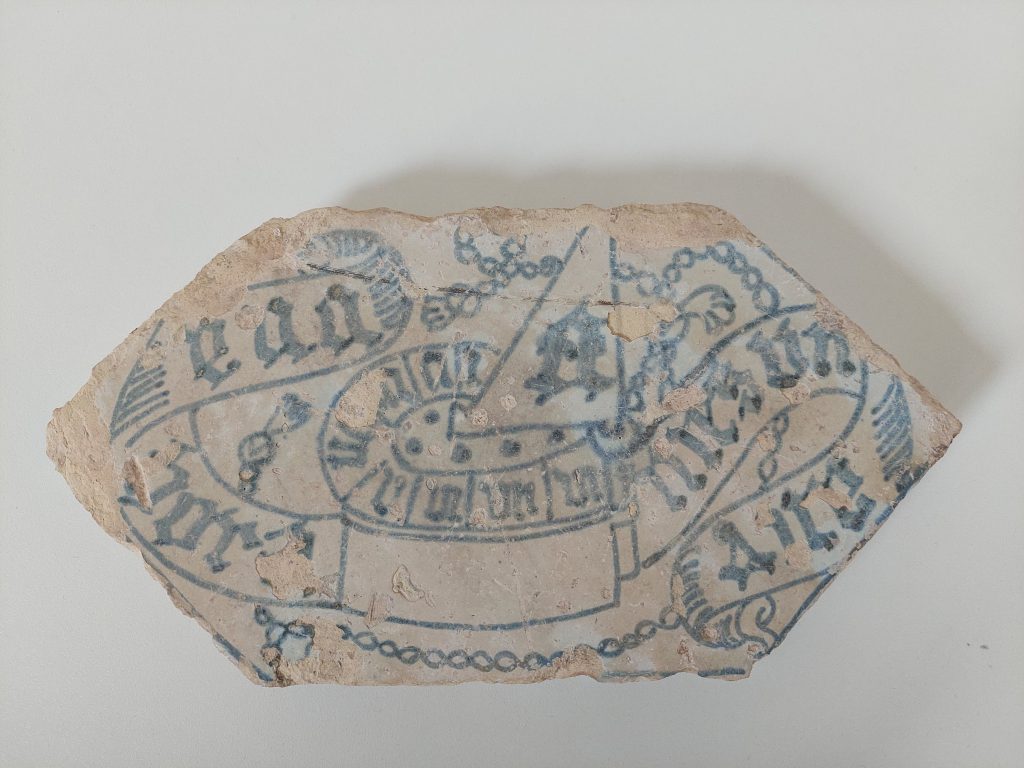
Tile, 15th-16th century, Glazed ceramic Molins de Rei Town Council MMMR
This tile was recently discovered during archaeological excavations carried out on the ground floor of the palace. It is an alfardón, a flattened hexagonal tile, very popular in the 15th century. It features a blue decoration with the phrase “One hour plus one year” surrounding a schematic drawing of a sundial, including its gnomon and hour markers. In 1444, when the palace was being built, Galceran de Requesens commissioned 2,500 tiles of this type from a ceramist in Manises, Valencia.
Molins de Rei
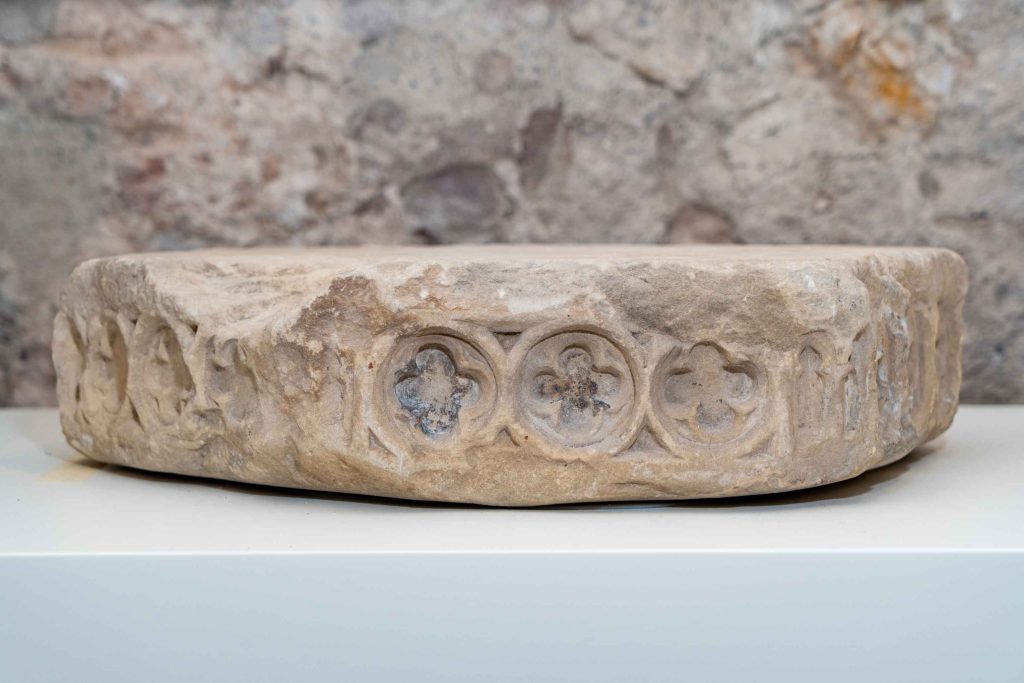
Impost, 15th-16th century, carved from sedimentary rock Molins de Rei Town Council MMMR 2030
This architectural feature, which had both a structural and an aesthetic function, has a series of Gothic-style decorations based on small openwork oculi. There is no documentary certainty that it comes from the Palau de Requesens, but it is highly probable, given the stylistic similarity to other ornamental elements, as well as the type of stone.
.
Palau de Requesens, Molins de Rei
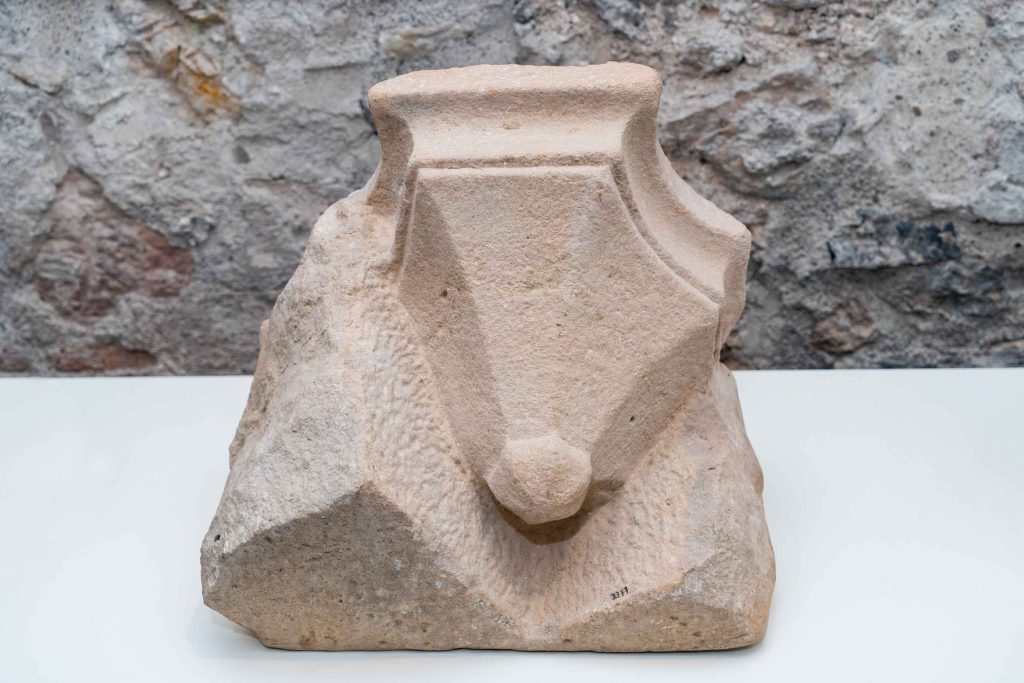
Cul-de-lampe, 15th-16th century, carved from sedimentary rock Molins de Rei Town Council MMMR 3377
Architectural feature of unknown provenance, possibly linked to the Palau de Requesens.
Molins de Rei
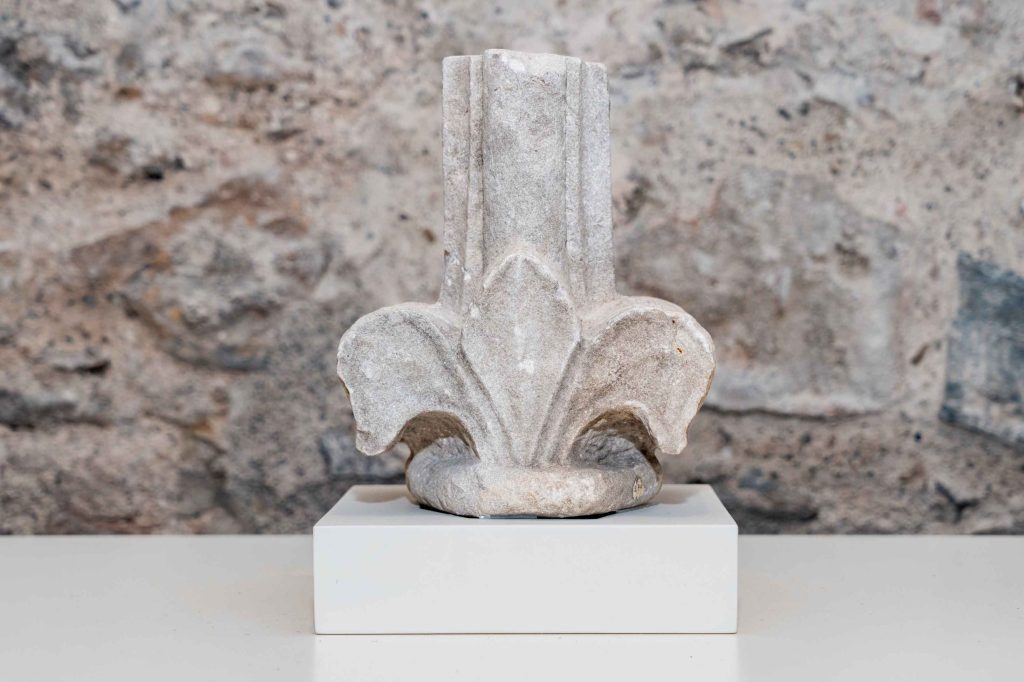
Column base, 15th-16th century, carved from sedimentary rock Molins de Rei Town Council MMMR 2026
Architectural feature of unknown provenance, possibly linked to the Palau de Requesens.
.
Molins de Rei
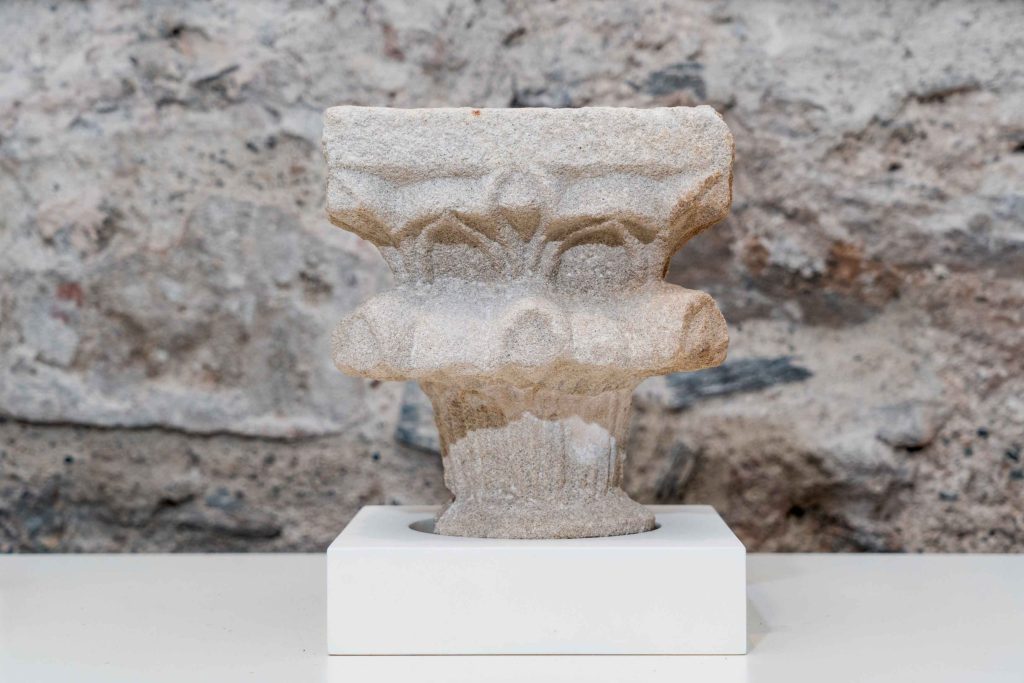
Capital, 15th-16th century, carved from sedimentary rock Molins de Rei Town Council MMMR 2038
Architectural feature of unknown provenance, possibly linked to the Palau de Requesens.
Molins de Rei
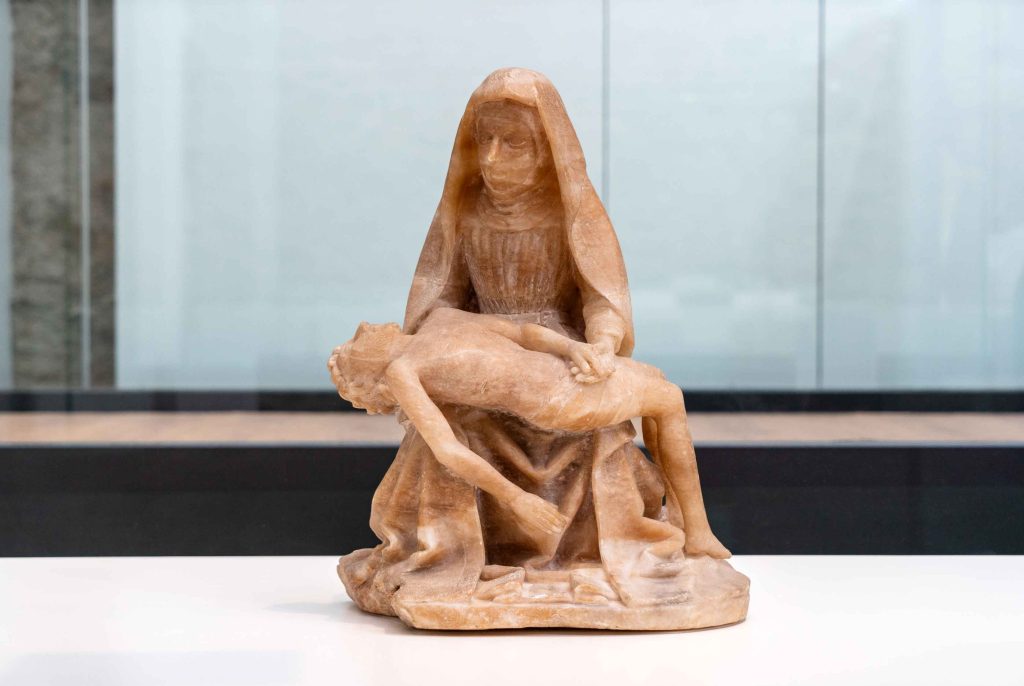
Pietà, 15th century, carved in alabaster Molins de Rei Town Council MMMR 1903
Alabaster carving depicting the body of the dead Christ on Mary’s lap after the Crucifixion.
The sculpture follows a compositional formula that was very popular at the time. Its origin is unknown, and the dating is approximate, although stylistically it could be from the 16th century or even later. In any case, due to its size and the quality of the carving, it was likely a piece belonging to an important location.
.
Molins de Rei
Wayside cross, 15th century, carved from sedimentary rock Molins de Rei Town Council MMMR 2042
Original wayside cross in late Gothic style marking the boundary of the town.
The cross was partially destroyed during the French War in the 19th century, losing both arms. Later, it became part of the Municipal Museum of Molins de Rei in its first location, at Can Samaranch. On one side, following a very common formula, the body of the crucified Christ is depicted, and on the other, the Virgin and Child stand. Today, a bronze reproduction with the arms restored can be seen in the Creu Square of Molins de Rei, made in 2007.
Molins de Rei
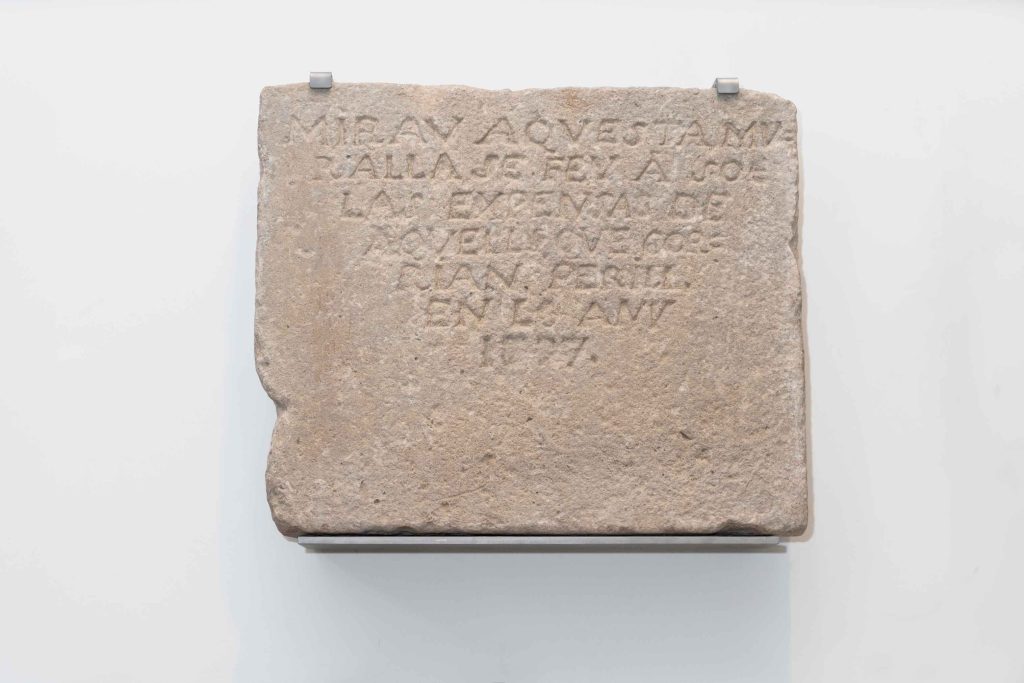
Stone from the Molins de Rei city wall, s. d., carved from sedimentary rock Molins de Rei Town Council MMMR 3491
A record of the fortification which, at a date that cannot be established with any certainty, must have surrounded the town of Molins de Rei, and to the way in which it was financed. The entire inscription is clearly legible, with the exception of one number: “Mirav aquesta mvralla se fev a soles expensas de aquells que corrian perill en lo any 1(5?)27” [This wall was financed solely by those who were in danger in the year 1(5?)27]. It might be 1527, when the Mediterranean was a very dangerous sea infested with pirates, who very often carried out raids near the coast and at river estuaries.
.
Palau de Requesens, Molins de Rei
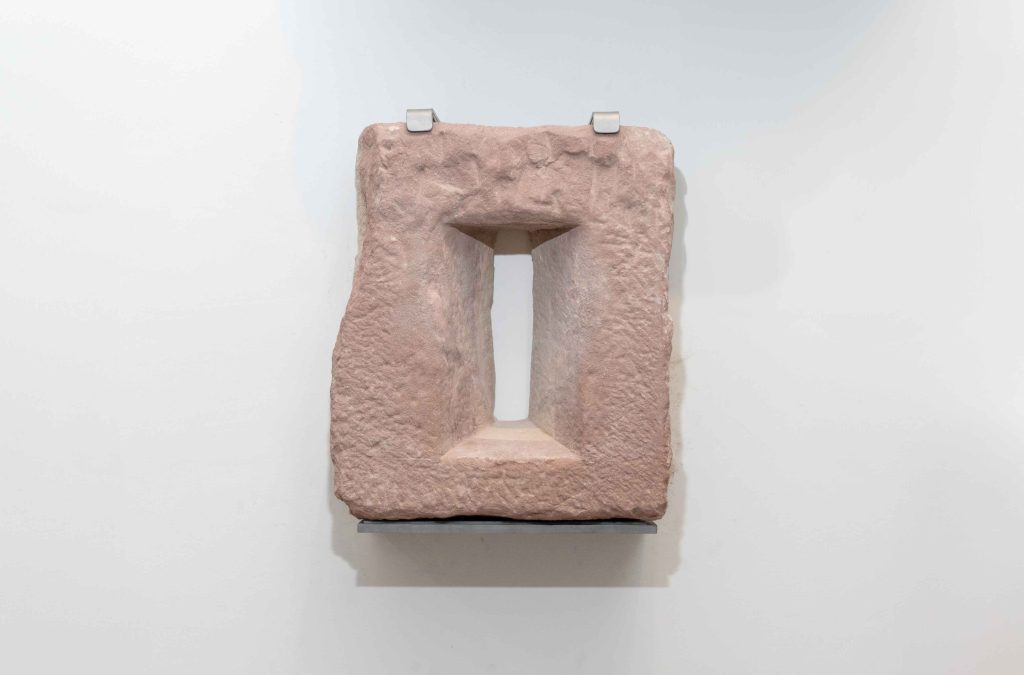
Embrasure, 15th-16th century, carved from sedimentary rock Molins de Rei Town Council MMMR 5816
The embrasure's small size and the characteristic funnel shape of the aperture, indicate its defensive function, for the purposes of observation and for shooting arrows from the inside with a crossbow. It should be remembered that security and defence were very much needed at the time the palace was built, even in a place like Molins de Rei.
Palau de Requesens, Molins de Rei
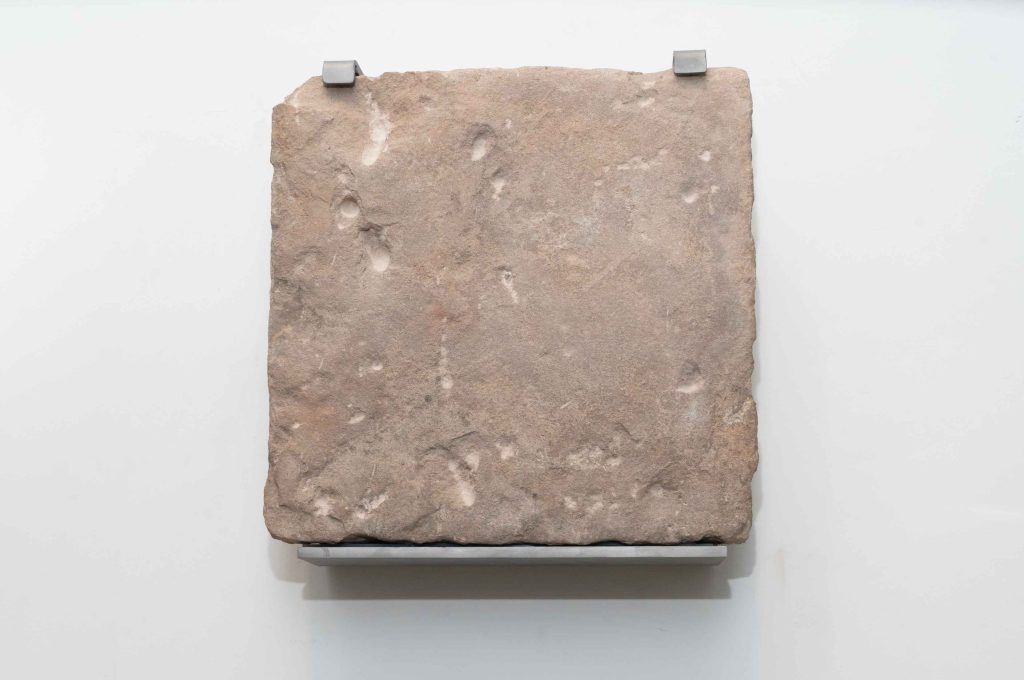
Paving slab, 15th-16th century, carved from sedimentary rock Molins de Rei Town Council MMMR 5815
Recovered during the excavation at the architectural site where the palace was built, this stone has been identified as a paving slab. It is a very simple stone, but the careful quadrangular stereotomy makes it possible to imagine the solidity and regularity that the original flooring that must have existed in part of the place.
.
Palau de Requesens, Molins de Rei
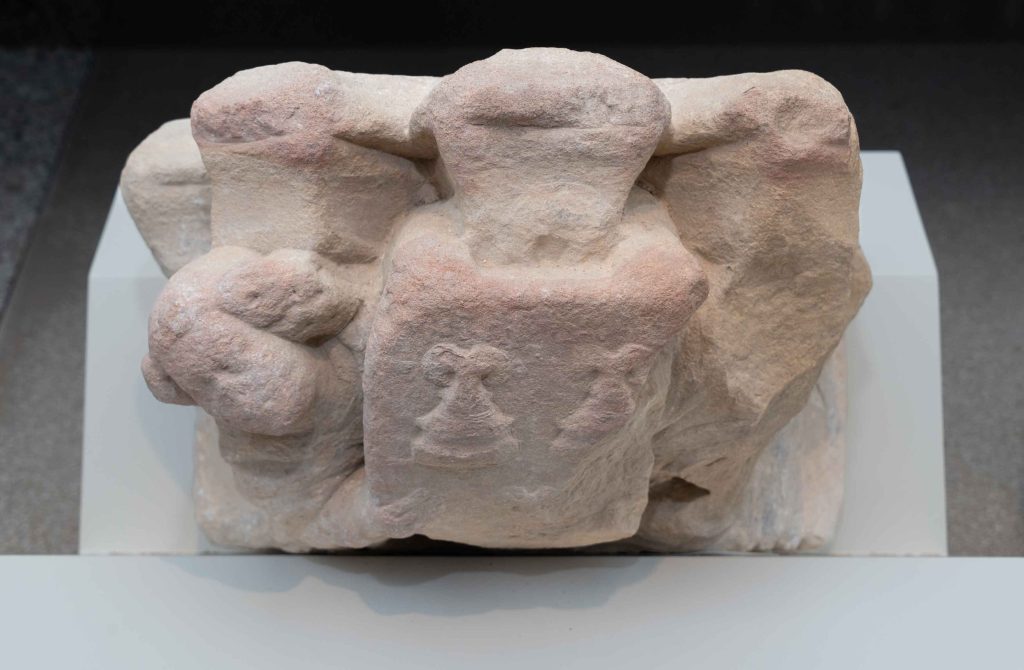
Arch keystone, 15th-16th century, carved from sedimentary rock Molins de Rei Town Council MMMR 2028
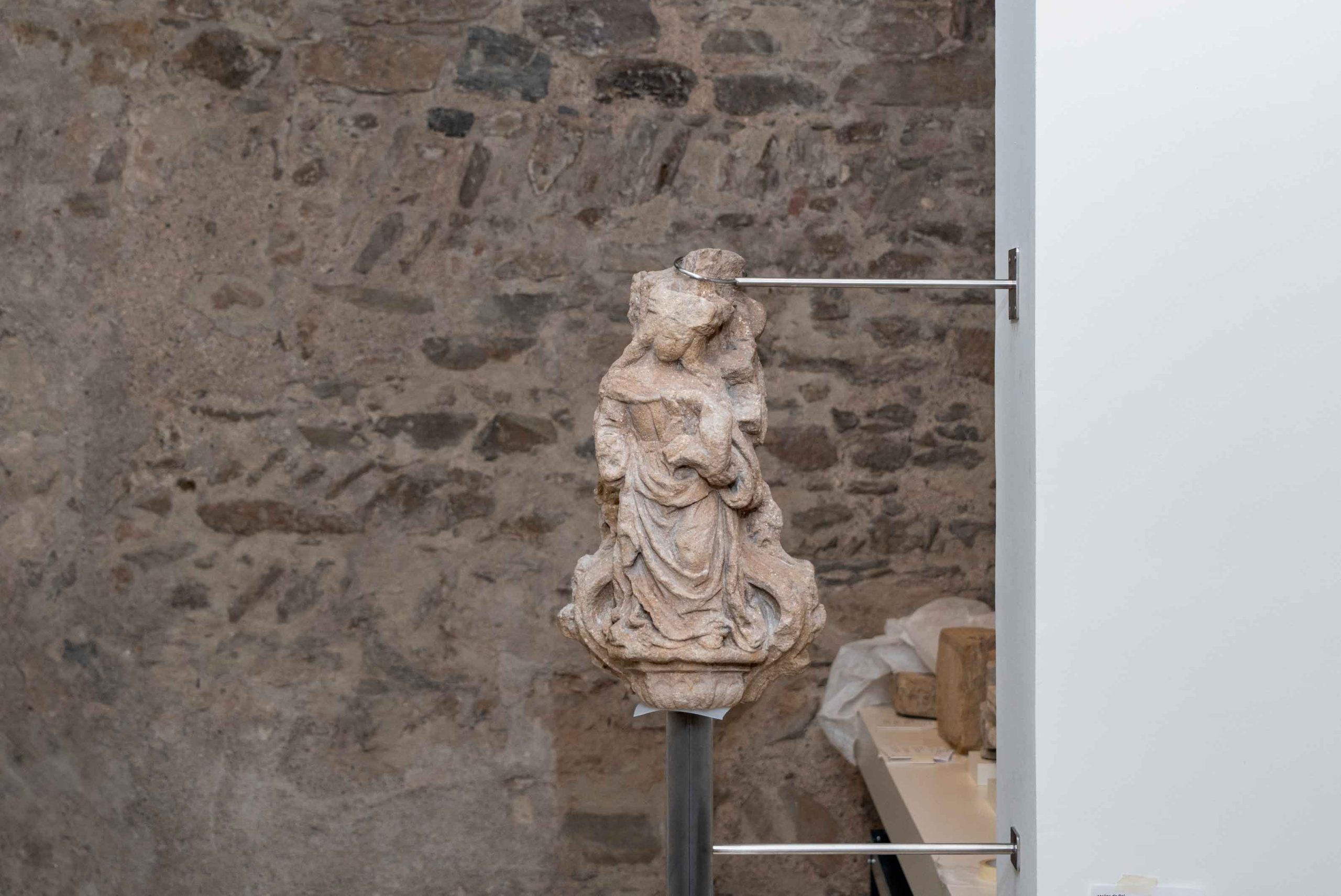
Corbel with a representation of a female figure or angel, holding the Requesens coat of arms. It is likely that this feature, which was both ornamental and functional, was located at the entrance or in a prominent place in the palace, as an indication of family ownership. Another symmetrical figure that would have supported the coat of arms on the other side is missing. As was common at the time, this architectural feature may have been polychromed in bright colours.
Palau de Requesens, Molins de Rei
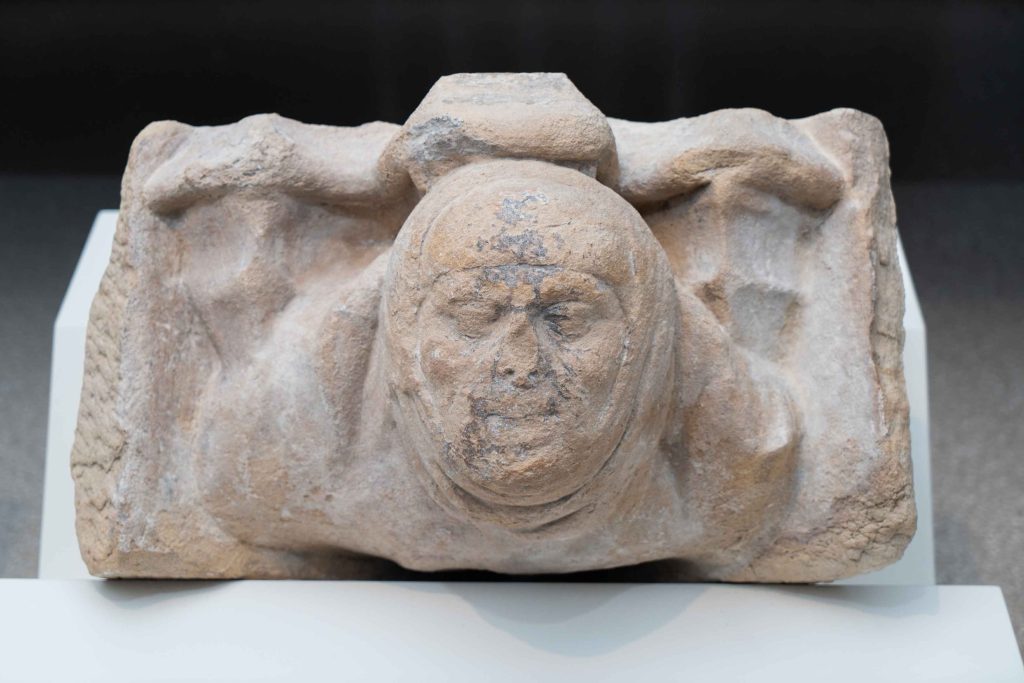
Arch keystone, 15th-16th century, carved from sedimentary rock Molins de Rei Town Council MMMR 2031
Corbel with a representation of the face of a female figure in the central part. Despite obvious wear and tear, the quality of the sculptural work and the decorative impact it must have had can still be clearly appreciated. It is also very likely that it was polychromed. Corbels are features that protrude from a wall and support the arches of a vault. [The word ‘corbel’ derives from the French word corbeau meaning crow, because of the corbel's beak-like shape].
.
Entrades recents
Comentaris recents
No s'han trobat comentaris.
Press Enter / Return to begin your search.
Have an Account?
To keep connected with us please login with your personal info.
We use cookies to improve your browsing experience, analyze web traffic, and personalize the content displayed. You can accept them all or configure them.
Functional
Always active
The storage or technical access is strictly necessary for the legitimate purpose of allowing the use of a certain service explicitly requested by the subscriber or user, or for the sole purpose of carrying out the transmission of a communication through an electronic communications network.
Preferences
Technical storage or access is necessary for the legitimate purpose of storing preferences that are not requested by the subscriber or user.
Statistics
Technical storage or access that is used exclusively for statistical purposes.Technical storage or access that is used exclusively for anonymous statistical purposes. Without a subpoena, voluntary compliance by your Internet service provider, or additional records from a third party, information stored or retrieved solely for this purpose cannot typically be used to identify you.
Màrqueting
L'emmagatzematge tècnic o l'accés són necessaris per crear perfils d'usuari per enviar publicitat o per fer un seguiment de l'usuari en un lloc web o en diversos llocs web amb finalitats de màrqueting similars.